文法
從屬子句
從屬子句
形容詞子句重要細節及簡化
形容詞子句的功用為形容詞,用以修飾前面的名詞,引導形容詞子句者為關係代名詞,
關係代名詞包括:
| 人 | 物 | |
| 主格 | who | which |
| that | that | |
| 受格 | whom | which |
| that | that | |
| 所有格 | whose | whose |
其它重要細節如下:
1. 格的判斷:關係代名詞格的判斷要看後面的結構
(a) 若N+____+VP,則空格用主格。
(b) 若N+____+S+ VP,則空格用受格。
(c) 若N+____+N,則空格用所有格。
例:1. People who lived three miles away heard the noise.
2. Mr. Wilson is a scholar whom we all admire. (whom當admire之受詞)
3. The house which he lived in was very big. (which當in之受詞)
4. I have just met the man whose son is a reporter.
2. 關係代名詞與先行詞的一致:關係代名詞指人或物要看先行詞。
例:1. Did you see the man who broke the window?
2. The meeting, which took place in the park, was attended by hundreds of people.
註:在“N+ who (which, that)+ VP”的結構中,動詞(V)的單複數要與先行詞一致。
例:1. These apple trees which (that) were planted ten years ago have borne a lot of fruit.
2. I talked to the man who is a lawyer.
3. that當關係代名詞的要點:(a)that可代替主格、受格,但不能代替所有格;(b)that當關係代名詞時所引導的子句前後不能標逗號;(c)that當關係代名詞時前面不能有介系詞。
下列例句皆需修改:
1. I bought the book that author was a famous statesman(政治家). (將that改為whose)
2. My uncle, that buys a new car every year lives in Chicago.
改為→My uncle that buys a new car every year, lives in Chicago.
或→My uncle, who buys a new car every year, lives in Chicago.
3. The book in that he is interested was written by Mark Twain.
改為→The book that he is interested in was written by Mark Twain.
或→The book in which he is interested was written by Mark Twain.
4. 受格關係代名詞(whom, which)若當介系詞之受詞,則介系詞可移至whom或which前面。
例:1. The house, which John lives in, is very big.
→The house, in which John lives, is very big.
→The house, where John lives, is very big. (in which指“地方”=where)
2. I talked to the man whom my brother worked with.
→I talked to the man with whom my brother worked.
5. 關係子句所形成的累贅結構。
例:1. The policeman and who caught him received a reward. (關係代名詞本身即為連接詞,故前不能再加連接詞,and要去掉)
2. The teacher who is from the United States. (who應去掉,否則The teacher便沒動詞)
6. 關係代名詞的簡化:主格與受格的關係代名詞可進行簡化,但所有格不能簡化。
(a) 主格關係代名詞的簡化:簡化步驟為去掉關係代名詞→去掉be動詞→動詞改為分詞,主動用現在分詞,被動用過去分詞。
請將下列例句簡化:
1. The girl who is sitting next to him is Mary.
→The girl sitting next to him is Mary. (現在分詞片語)
2. Dr. Lin, Who is the president of the university, will give a speech tonight.
→Dr. Lin, the president of the university, will give a speech tonight. (名詞片語)
3. The house which is on top of the mountain belongs to my uncle.
→The house on top of the mountain belongs to my uncle. (介系詞片語)
4. The writer used a writing style which was different from the traditional one.
→The writer used a writing style different from the traditional one. (形容詞片語)
5. The psychologists who study the nature of sleep have made important discoveries.
→The psychologists studying the nature of sleep have made important discoveries. (現在分詞片語)
6. They live in a house that was built hundreds of years ago.
→They live in a house built hundreds of years ago. (過去分詞片語)
7. The ideas which are presented in that book are interesting.
→The ideas presented in that book are interesting. (過去分詞片語)
由上述句得知主格關係代名詞簡化後可成為名詞片語、形容詞片語、介系詞片語、現在分詞片語,或過去分詞片語。
(b) 受格關係代名詞之簡化:受格關係代名詞(whom, which)皆可簡化,但若該子句前後標逗號則不能簡化。
例:1. The man (whom) I met yesterday is my old friend. (whom可省略)
2. The man, whom I met yesterday, is my old friend. (whom不可省略)
7. 複合關係代名詞:下列表格即說明這類代名詞的功用與結構。
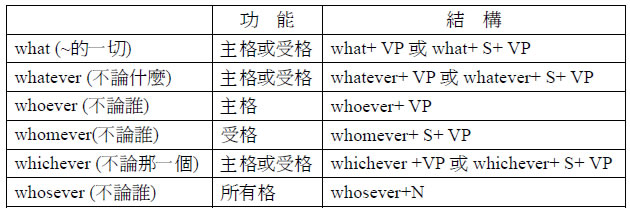
注意要點:
(a) 複合關代前面不能有名詞當先行詞。
(b) 複合關代引導名詞子句,整個子句作主詞,受詞或補語。
例:1. He is interested in whatever is said. (當in之受詞)
2. You may give the prize to whomever you like. (當to之受詞)
3. Whoever breaks the law should be punished. (當主詞)